

Research Summary · 10 Sources · March 2026
Graphs Reduce LLM Hallucinations.
Here’s the proof.
The results are in, and the evidence? Irrefutable. Graph databases, when used with specific prompting techniques, make LLMs give better answers.
Here’s the research.
Sources & Findings
Conclusions
Graph structure preserves relationships
Entity relationships that flat RAG destroys are preserved in graph form — this is why chunk-based retrieval plateaus on complex queries.
Temporal provenance enables reasoning
Bitemporal modeling lets agents reason about what changed, when, and why — not just what’s true now. This cuts token waste on stale context.
Provenance + AuthZ at the graph layer
You can enforce who sees what evidence — critical for enterprise trust. Authorization evaluated at query time, not ingestion.
Prevention beats detection
Architectural citation constraints (must-cite-source) outperform probabilistic hallucination detection. Force the model to ground its claims.
Schema-as-code for knowledge graphs
Treating extraction prompts as deployable config turns a one-off project into a platform. Fewer tokens, more structure.
The stack is converging
Graph memory + explicit provenance + structured prompting is the emerging stack for trustworthy LLM systems with lower token budgets.
Open Source Tooling
Dgraph Viewer
github.com/corewood-tech/dgraph-viewer
A lightweight, browser-based graph explorer for Dgraph databases. Inspired by Neo4j’s browser interface, distributed as a single Go binary with zero dependencies.
Toggle between Three.js 3D rendering and D3.js 2D SVG views while preserving graph state. Explore nodes incrementally via double-click expansion with radial glow highlighting that reveals BFS-ranked connections. Type-specific platonic solids — icosahedron, octahedron, dodecahedron — make entity types instantly distinguishable.
Read-only by design: all mutation queries are blocked at the proxy layer. Live-switch between Dgraph instances without restart.
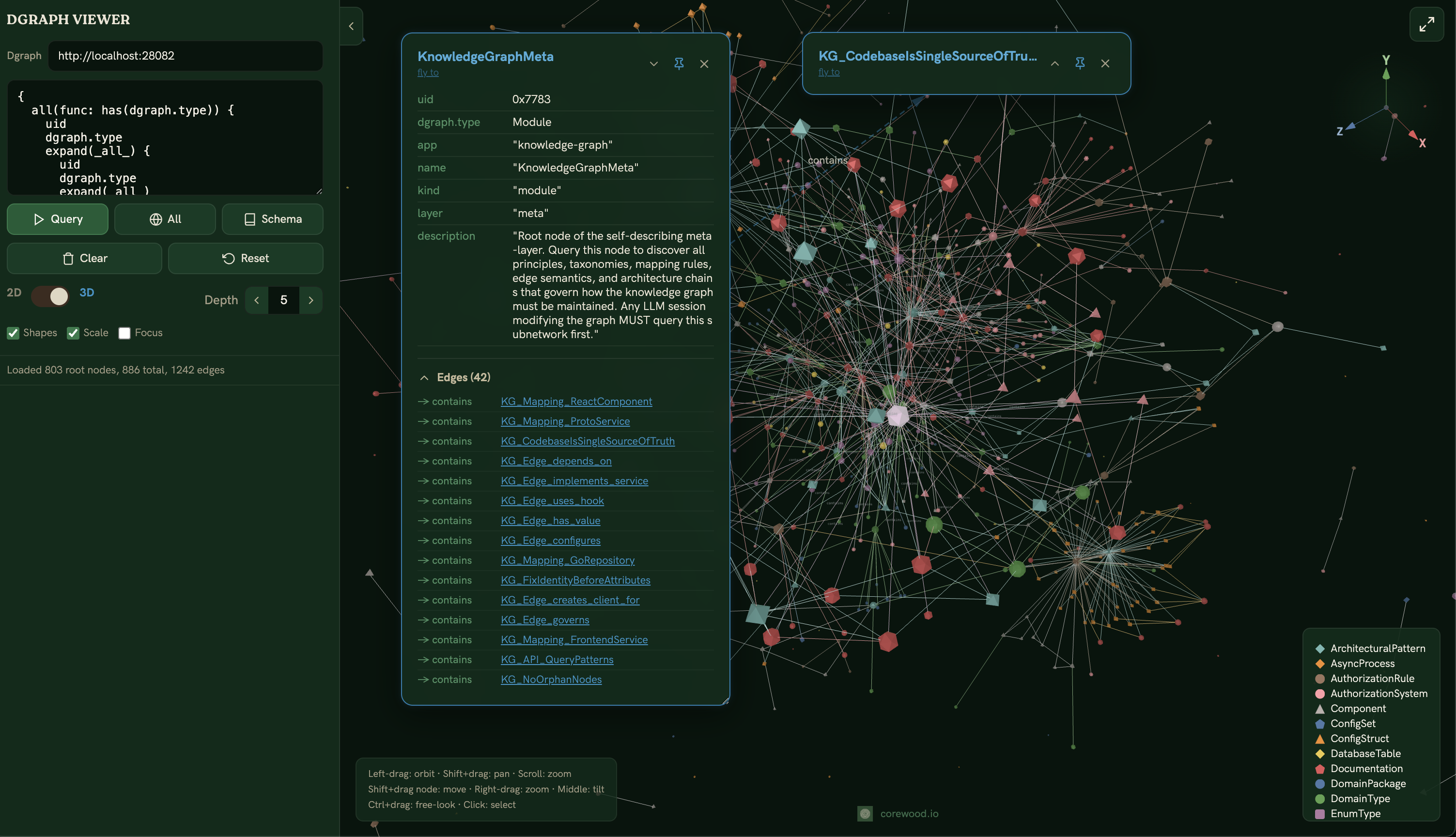
3D force-directed graph visualization with DQL query editor and schema inspector
Provenance Chain
generated_by: Claude Opus 4.6
retrieval_method: web_search → 5 queries → 50 results → filtered to 10 sources
sources_verified: URLs point to arxiv, GitHub, ACL Anthology, OpenReview
citation_constraint: all findings paraphrased from search results with inline attribution
hallucination_risk: LOW — all claims grounded in retrieved documents, but verify URLs yourself
This provenance block was generated by the same LLM that made the content above.
The irony is not lost on us. That’s the whole point.
Trust graphs, not tokens.
Building graph-backed AI systems that earn trust?
Talk to Corewood